Facial thirds and fifths
The oldest proportion check there is, how to run it on your own face, and how much the answer is worth.
Thirds divide the face into three horizontal bands that the classical ideal says should be roughly equal. Fifths divide it into five vertical columns, each about one eye wide. Neither is a rule anyone's face obeys exactly, and the useful information is in which direction you sit off centre.
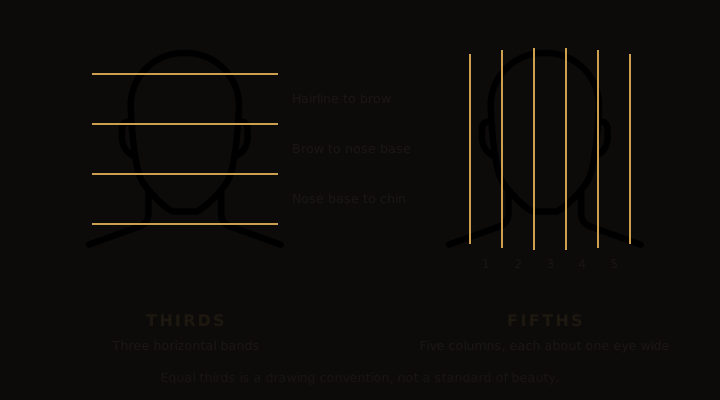
The thirds
Three horizontal bands, measured on a straight on photo with the head level:
| Band | From | To |
|---|---|---|
| Upper | Hairline | Brow line |
| Middle | Brow line | Base of the nose |
| Lower | Base of the nose | Bottom of the chin |
Equal thirds is the classical target, inherited from Renaissance drawing convention rather than from any modern evidence that equal thirds are what people find attractive. Take it as a description of a common pattern, not a law.
Where you sit off equal is the part worth knowing:
- Top heavy. A tall upper third, usually a high or receding hairline. The one that changes on its own over time, in one direction.
- Mid heavy. A long midface, from brow to nose base. Fixed in adults, and the least responsive of the three.
- Bottom heavy. A long lower third. Reads as a strong lower face when the jaw is defined, and as a heavy one when it is not, which is why this band moves the most with body fat.
The fifths
Five vertical columns across the widest part of the face, each ideally about one eye width:
- Outer edge of the face to the outer corner of the left eye
- The left eye
- The gap between the eyes
- The right eye
- Outer corner of the right eye to the outer edge of the face
The middle column is the one that tells you something. If the gap between your eyes is wider than one eye, the description is wide set. Narrower, and it is narrow set. Both are common, both are entirely normal, and neither is fixable, so this measurement is purely for understanding your face rather than for doing anything about it.
Measuring it properly
The measurement is only worth as much as the photo, and most people's photos are not worth much. Four things to get right:
- Camera at eye level. A phone held high shortens the lower third and lengthens the upper. Held low, the reverse. This single error produces most of the wrong answers people get.
- Straight on. Any yaw and the fifths stop being comparable, because the far side of the face is foreshortened.
- Neutral expression, mouth closed. A smile shortens the lower third.
- Hair off the forehead, or you are measuring your fringe rather than your hairline.
Then measure in pixels in any image editor. Ratios are what matter, so units are irrelevant, and the comparison is band against band rather than against any absolute number.
What actually moves
The skeleton is fixed once you have finished growing, so the ratios themselves are not going anywhere. Three things still change what people see:
- Body fat. The lower third carries most of the visible change. Losing fat sharpens the jaw line and changes how long the lower third reads, without the bone moving at all.
- Hair. The upper third is the one band with a genuine lever on it, and it works in both directions. A different cut changes the apparent hairline, and the shape you choose can lengthen or shorten the band on purpose.
- Beard. A beard adds visual length to the lower third and can square off a narrow chin. This is the standard fix for a face that reads short in the lower band.
Anything promising to change your midface length is not being honest with you.
How Forma reports it
Forma places your thirds in one of four categories, balanced, top heavy, mid heavy or bottom heavy, and your fifths in one of three, balanced, narrow set or wide set. Categories rather than numbers, deliberately: a phone photo does not support a precise ratio and any tool handing you one to two decimal places is inventing precision it cannot have.
It also reports harmony separately, which is a different question from proportion. Harmony is how close the whole arrangement sits to the population average, and being distinctive there is not the same as being off balance.
Common questions
- What are the facial thirds?
- Three horizontal bands: hairline to brow, brow to the base of the nose, and base of the nose to the bottom of the chin. The classical ideal has them roughly equal, and most real faces are somewhere off that.
- What are the facial fifths?
- Five vertical columns across the face, each about one eye width. Outer edge of the face to the outer corner of the eye, the eye itself, the gap between the eyes, the other eye, and the last column out to the far edge.
- Can you change your facial proportions?
- The skeletal ratios are fixed in adults. What moves is soft tissue: body fat changes the lower third, hairline changes the upper one, and a beard or a haircut changes how the bands read without changing the measurement.
On Android? Get it on Google Play
Forma is a self improvement tool, not a medical or diagnostic service. Facial proportion is a description, not a verdict, and the classical ideals on this page are drawing conventions rather than evidence about what people find attractive.
Related guides
- Canthal tiltThe angle between your inner and outer eye corner, and which parts of it move.
- Facial symmetryHow asymmetric a normal face is, and why perfect symmetry looks wrong.
- How to take the photoThe setup that decides whether your ratios mean anything.
- Face shapeThe classification your proportions feed into.
- Philtrum lengthThe measurement inside your lower third.
- Midface ratioThe middle band, measured against your eye width.