Face shape
Three comparisons separate all seven shapes, and you can make them on a photo without a tape measure.
Compare face length against face width, forehead width against jaw width, and find the widest point. Those three answers give you the shape. It is a description of your proportions, not a ranking.
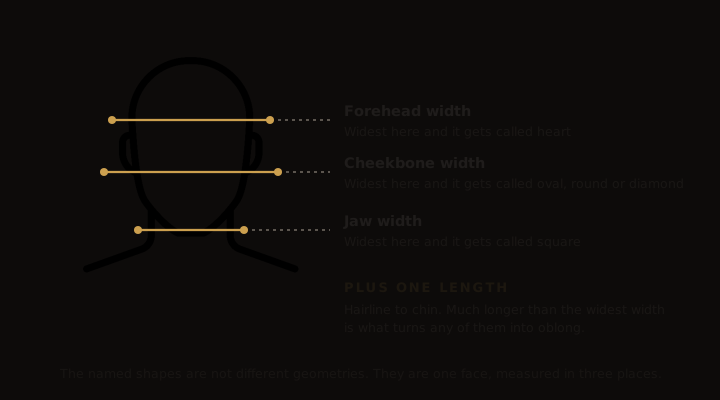
The three comparisons
On a straight on photo, taken at eye level with your hair off your forehead:
- Length against width. Hairline to chin, versus the widest horizontal point. Roughly equal, or clearly longer than wide?
- Forehead against jaw. Which is wider, and by how much?
- Widest point. Is it the forehead, the cheekbones or the jaw?
Nothing here needs a ruler. You are comparing two lengths in the same image, so eyeballing gets most people to the right answer, and an image editor settles the close calls.
The seven shapes
| Shape | How it reads |
|---|---|
| Oval | Longer than wide, forehead slightly wider than the jaw, no hard angles anywhere. |
| Round | Length and width close to equal, widest at the cheeks, soft jaw line. |
| Square | Length and width close to equal, forehead and jaw similar width, and a visible angle at the jaw. |
| Heart | Forehead clearly the widest, narrowing to a pointed chin. |
| Oblong | Noticeably longer than wide, with forehead, cheeks and jaw all similar width. |
| Diamond | Cheekbones the widest by a clear margin, with both forehead and chin narrower. |
| Triangle | Jaw the widest point, narrowing upward to the forehead. |
Most people land between two of these, and that is normal rather than a failure of the test. If you are between round and square, the deciding question is the jaw: a visible corner means square, a curve means round.
What your shape actually changes
Not much about how attractive you are. Quite a lot about which haircut and beard work without a fight, which is the only genuinely useful thing this classification does.
- Oval. The most forgiving. Keep some volume on top and the face open, and almost anything works.
- Round. Add height and angle: volume up top, shorter sides, and a defined or stubbled jaw to lengthen the face.
- Square. Work with the jaw rather than hiding it. Textured tops and softer, shorter sides balance the angles; light stubble suits.
- Heart. Balance the wider forehead with fuller sides, and a little beard at the chin to add width low down.
- Oblong. Do not add height. Shorter on top, fuller at the sides, and a fuller beard widens the face.
- Diamond. Soften the cheekbones with fuller sides or a fringe, and let a little beard fill out the narrower chin.
- Triangle. Volume and width up top to balance the wider jaw, with the beard kept tidy and tapered.
The pattern underneath all of it: you are adding width where the face is narrow and length where it is short. Once you see that, you can work out the answer for any shape without memorising the list.
Why people get a different answer every time
Three reasons, and none of them is your face being unclassifiable.
Camera height changes the ratio directly, since shooting from above lengthens the top of the face and narrows the jaw. Hair over the forehead hides the hairline, so you end up measuring the fringe. And body fat rounds the lower face, which is why the same person can read square at one weight and round at another, on unchanged bone.
Take the photo properly and the answer stops moving.
How Forma reports it
Forma names one of these seven and pairs it with the styling note for that shape, in the same categories used above. It is reported alongside the proportions rather than inside the score, deliberately: shape informs what suits you, and it is not a thing you are marked on.
Common questions
- How do I find my face shape?
- Compare three things on a straight on photo: face length against face width, forehead width against jaw width, and where the face is widest. Those three separate all seven shapes without a tape measure.
- Does face shape change?
- The underlying shape does not, since it is bone. What changes is how it reads: body fat rounds the lower face, a beard squares a narrow chin, and a haircut changes the apparent width of the top. Plenty of people who think their shape changed have changed weight.
- Is one face shape better than another?
- No. Oval gets called the most versatile because more haircuts suit it without adjustment, which is a statement about hairdressing rather than about attractiveness. Every shape has cuts and beards that work with it.
On Android? Get it on Google Play
Forma is a self improvement tool, not a medical or diagnostic service.
Related guides
- Facial thirds and fifthsThe proportion check underneath the shape classification.
- Jawline definitionThe jaw is the deciding line between half of these shapes.
- How to take the photoWhy your shape seems to change between photos.
- CheekbonesThe width that decides which shape you land in.
- Midface ratioThe height measured against that width.