Canthal tilt
What the angle is, how to measure your own from a photo, and which parts of it are actually movable.
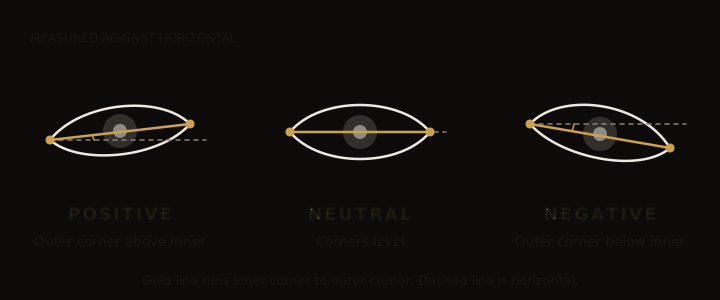
Canthal tilt is the angle of the line running from the inner corner of your eye to the outer corner, measured against horizontal. Outer corner higher is positive. Level is neutral. Outer corner lower is negative. Most adults sit a few degrees positive.
The two corners have names, which is where the term comes from. The inner corner, next to the nose, is the medial canthus. The outer corner is the lateral canthus. Draw a line between them and compare it to a horizontal line through the inner corner, and the angle you get is the canthal tilt.
It gets talked about far more than it deserves, usually as though it were a single number that decides whether a face works. It is not that. It is one measurement of one feature, and the sections below cover what it does and does not tell you.
Positive, neutral and negative
| Tilt | What it looks like |
|---|---|
| Positive | Outer corner sits above the inner corner. The common adult pattern, typically a few degrees. |
| Neutral | Corners level, or close enough that a photo cannot separate them. |
| Negative | Outer corner sits below the inner corner. Reads as a downward slope at the outer eye. |
The range usually quoted for adults is around 4 to 7 degrees positive, but the figure moves with ancestry and with the study you read, and the honest position is that there is no single correct number. A neutral tilt is not a defect. Plenty of faces widely considered attractive measure close to zero.
How do you say it
Canthal is said KAN-thuhl. Two syllables, stress on the first, and the th is soft as in thing rather than hard as in that. It rhymes with mantle.
Canthus, the singular noun for one corner, is KAN-thuss. The plural is canthi, said KAN-thigh. The word comes from the Greek kanthos, the corner of the eye.
How to measure your own
You need one photo and something that can measure an angle. A protractor app works, so does any image editor with a line tool that reports degrees.
- Camera at eye level, straight on. This is the step everybody skips and it is the step that decides whether the number means anything. A camera held above you tilts the whole eye line and manufactures a positive result. Held below, it manufactures a negative one.
- Neutral face. No smile. Smiling lifts the cheek into the lower lid and changes the apparent corner position.
- Head level. Use something horizontal in the background as a reference, or check that both pupils sit on the same horizontal line.
- Mark both corners on one eye, draw the line, and measure the angle against horizontal.
- Do the other eye separately. They rarely match exactly and the difference between them is worth more attention than the average of the two.
Repeat it on a different day before you believe it. Eye tissue is one of the first places overnight fluid retention shows, so the same face at 8am and 8pm can read differently by a degree or two.
What changes it, and what does not
The angle is set by where the lateral canthal tendon attaches to the orbital rim. That is bone and connective tissue. No cream, massage, exercise or supplement moves the attachment point, and anything sold on the promise that it does is selling to people who have not asked this question yet.
What does move is how the tilt reads, and that is a real distinction rather than a consolation prize:
- Fluid and swelling. Puffiness in the lower lid blunts the outer corner and flattens the apparent angle. Sleep, salt and alcohol all show here first.
- Allergies. Chronic rubbing and swelling around the eye change the look of the outer corner, and treating the allergy changes it back.
- Under eye shadowing. Darkness under the lower lid drags the eye visually downward whatever the actual angle is doing.
- Brow position and shape. The brow tail sits directly above the outer corner, and where it goes changes how the corner is read. This is why brow grooming makes a difference out of proportion to the effort.
- Age. The tendon loosens over decades and tilt tends to drift down. That is normal ageing, not something that happened to you specifically.
Surgical procedures, canthoplasty and canthopexy, do change the attachment. They are real operations with real recovery and real failure modes, and this page is not the place to be talked into or out of one. If it is on your mind, that is a conversation with an oculoplastic surgeon, not with a website.
How much it actually matters
Less than the internet suggests. A couple of degrees of tilt is a small signal next to skin clarity around the eye, whether you look rested, and whether the brow above it is tidy. Those three are also the ones you can move in weeks rather than never.
The useful way to hold it: canthal tilt is worth knowing, because it tells you which changes are available to you and which are not. It is not worth fixating on, because it is one of nine or ten features and the least responsive of them.
How Forma reports it
Forma scores canthal tilt as one of nine finer traits, alongside cheekbones, jaw angle, chin, midface, brow, nose, lips and hairline. Each is placed in a band rather than given a false precision number, because a phone photo cannot support two decimal places and pretending otherwise would be dishonest.
It also sits inside the eye score rather than standing alone, which matches how it works in practice: the eye area is read as a whole, and the tilt is one contributor to it.
Common questions
- How do you pronounce canthal tilt?
- Canthal is said KAN-thuhl, two syllables with the stress on the first, and a soft th as in thing. It rhymes with mantle. The singular noun canthus is KAN-thuss and the plural canthi is KAN-thigh. The word comes from the Greek kanthos, meaning the corner of the eye.
- What is a normal canthal tilt?
- Most adult eyes sit a few degrees positive, meaning the outer corner is slightly higher than the inner corner. Roughly 4 to 7 degrees is the range usually quoted, and it varies with ancestry, so a number outside it is a difference rather than a fault.
- Can you change your canthal tilt without surgery?
- The angle itself is set by where the canthal tendons attach to bone, and nothing topical moves that. What does change is how visible it is: swelling, poor sleep, allergies and under eye shadowing all flatten the appearance of the outer corner, and fixing those changes how the eye reads without changing the underlying angle.
- Does canthal tilt actually matter for attractiveness?
- It is one input among many and a small one on its own. Skin quality around the eye, brow shape and how rested you look account for far more of the impression than a couple of degrees of tilt.
On Android? Get it on Google Play
Forma is a self improvement tool, not a medical or diagnostic service. Nothing here is medical advice. If something about your eyes has changed recently, or changed on one side only, that is a question for a doctor rather than a face rating app.
Related guides
- Facial thirds and fifthsHow to check your own proportions from a single photo, and what balanced actually means.
- Facial symmetryHow asymmetric a normal face is, and why perfectly symmetric faces look wrong.
- How to take the photoCamera height fakes this measurement more easily than any other.
- Dark circles and under eye bagsThe other half of the eye area, and the part that responds fastest.
- Brow ridge and brow positionThe brow tail visually extends the eye, and it moves in twenty minutes.
- Why you look worse in photosCamera height fakes the tilt more convincingly than anything else.