Philtrum length
The strip of skin between your nose and your top lip. It is judged as a ratio rather than a measurement, it lengthens as you age, and the most popular thing people do about it makes it worse.
Compare the nose to lip distance against the lower lip to chin distance. Around one to two is the usual reference. A long philtrum reads older and heavier in the lower face, it cannot be shortened without surgery, and lip filler lengthens the look of it rather than fixing it.
The philtrum is the vertical groove running from the base of the nose down to the middle of the upper lip, along with the flat skin either side of it. Almost nobody thinks about it until they see a photo taken from slightly above and wonder why their mouth suddenly looks far from their nose. It is one of the few facial measurements where the number itself matters less than the ratio, and one of the very few where a popular cosmetic procedure reliably works against the goal.
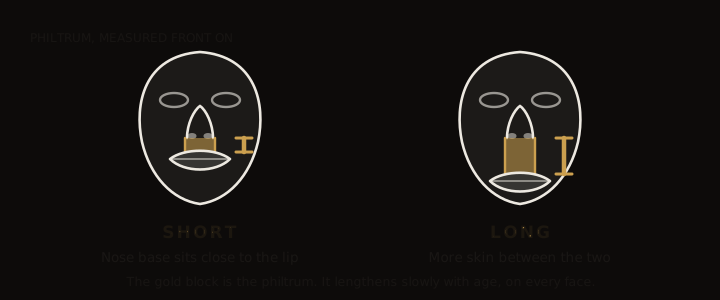
How to measure it
You need a straight on photo at eye level with a relaxed, closed mouth. Do not smile, because a smile lifts the upper lip and shortens the philtrum temporarily, which is exactly the flattering distortion you are trying to avoid.
- Distance A: from the base of the nose, where it meets the skin, to the top edge of the upper lip where the red begins.
- Distance B: from the bottom edge of the lower lip to the bottom of the chin.
Compare A to B. The common reference point is roughly one to two, so B about twice A. Above that and the philtrum reads short, below it and it reads long. There is no correct number in millimetres, because a larger face has larger everything, which is the reason comparing your own measurement to a number you read somewhere is meaningless.
Why it matters more than its size suggests
Philtrum length is one of the strongest age signals in the lower face, and it is one of the differences between a face read as feminine and one read as masculine. A shorter philtrum with more visible upper tooth at rest reads younger. A longer one with the upper lip hanging flat and no tooth showing reads older, regardless of skin quality.
It also affects how the whole middle of the face is perceived. A long philtrum pushes the mouth further from the nose, which lengthens the apparent lower third and can make an otherwise balanced face read as bottom heavy. That interacts directly with facial thirds, where the lower third is the band it sits inside.
Why lip filler makes a long philtrum look longer
This is the single most useful thing on this page, and it is the opposite of what most people assume.
Filler adds volume to the body of the lip. Volume pushes the lip forward and, as it fills, downward and outward. It does not lift the skin above the lip border upward toward the nose. The philtrum is the skin between the nose and that border, so nothing about adding volume below the border shortens the distance above it.
Worse, a fuller lower face draws the eye down, and an inflated upper lip can roll the border slightly outward, which makes the flat skin above it read as a larger, blanker area. People who go in wanting a smaller gap between nose and mouth frequently come out with the gap looking bigger.
| What you want | What actually does it |
|---|---|
| Shorter philtrum | A lip lift, which is surgery. It removes a strip of skin under the nose and physically raises the lip. |
| More visible upper lip | Filler can genuinely do this, and it is a different goal from shortening the philtrum. Worth being clear which one you actually want. |
| A shorter looking philtrum in photos | Camera at eye level or very slightly below, chin neutral rather than tucked. Tilting your head down is what lengthens it in most bad photos. |
| Nothing at all | A perfectly reasonable answer. It is anatomy, it is extremely common, and it is not a flaw. |
What changes it and what does not
Age changes it. The upper lip deflates and the skin lengthens, slowly and continuously, from the twenties onward. This is normal and universal.
Weight does not change it. Unlike the jaw or the cheeks, this distance is not a fat storage area. Losing body fat will sharpen a great deal of your lower face and will do nothing at all here.
Camera height changes how it looks enormously. A phone held above eye level, which is how most selfies are taken, foreshortens the forehead and stretches the area between nose and mouth. If your philtrum looks dramatically different between two photos, the camera moved rather than your face. This is the same effect covered in how to take the photo.
How Forma reports it
Philtrum length feeds the proportions read rather than appearing as its own headline score, and it sits with the other lower third measurements. That placement is deliberate: on its own the number is not very actionable, and the honest output for most people is that it is fixed. The plan will not hand you a task for it, because there is no task that works, and inventing one would be the kind of thing this app exists not to do.
Common questions
- What is a good philtrum length?
- It is judged as a ratio rather than a measurement in millimetres. The distance from the base of the nose to the top of the upper lip is usually compared to the distance from the bottom of the lower lip to the bottom of the chin, and roughly one to two is the common reference. Your own face size decides the absolute number, which is why comparing your millimetres to someone else's tells you nothing.
- Does lip filler shorten the philtrum?
- No, and it often makes a long philtrum look longer. Filler adds volume to the lip body, which pushes the lip forward and downward rather than lifting the space above it. The philtrum is skin between the nose and the lip border, and adding volume below that border does not shorten it.
- Can you shorten a philtrum without surgery?
- Not the actual length. The distance is set by the underlying anatomy and by how much the upper lip has descended with age. A lip lift is the surgical option and it removes skin under the nose. Everything non surgical changes how visible the philtrum is rather than how long it is: posture of the head, camera height, and how much of the upper teeth show when you smile.
- Why does the philtrum get longer with age?
- The upper lip loses volume and the skin between the nose and the lip gradually lengthens and flattens. The visible red part of the lip rolls inward as it deflates, so the distance from the nose to the top of the visible lip grows even when the bone has not moved. This is one of the more reliable age markers in the lower face.
On Android? Get it on Google Play
Forma is a self improvement tool, not a medical or diagnostic service. Nothing here is medical advice, and nothing here is a recommendation for or against any cosmetic procedure. Anything involving surgery or injectables is a conversation for a qualified practitioner.
Related guides
- Facial thirds and fifthsThe lower third is the band your philtrum sits inside.
- Chin projectionThe other half of the lower third, and the one that changes the profile more.
- How to take the photoCamera height distorts this measurement more than almost any other.