Facial symmetry
How to test your own, why the mirrored half trick misleads everyone who tries it, and which asymmetries are worth doing anything about.
Every face is asymmetric. Yours is too, and so is the face of everyone you have ever found attractive. What matters is the size of the difference and whether it sits in the soft tissue, which can move, or the skeleton, which cannot.
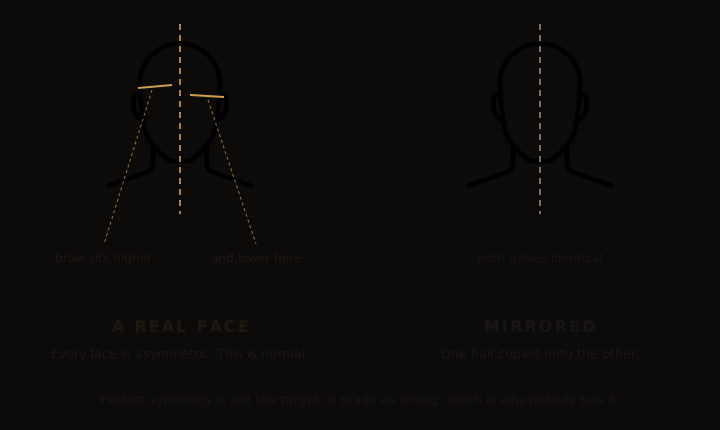
Why the mirror trick is misleading
The popular test is to mirror one half of your face onto itself and look at the result. It always looks wrong, and people take that as evidence of a problem.
It looks wrong for two reasons that have nothing to do with your face being unusual. First, a mirrored composite is not a real human face, and faces built that way land in the uncanny space where something is off but you cannot name it. Second, you have spent your whole life looking at your actual face, and the mirrored one is a stranger.
Run the same trick on any face you consider attractive and you get the same unsettling result. It is not a measurement, it is a party trick.
A test that tells you something
Compare landmark positions instead of mirroring halves.
- Straight on photo, camera at eye level, neutral expression, head level. Same conditions as any other facial measurement, and the same reason: a tilted head manufactures asymmetry that is not there.
- Draw a vertical line through the middle. Use the bridge of the nose and the centre of the philtrum, not the tip of the nose, which is frequently off centre on its own.
- Mark and compare, side against side: brow height, eye height and eye opening, cheekbone position, mouth corner height, jaw angle.
- Note which direction each one differs. A face where everything leans the same way tells a different story from one where the differences are scattered.
Small differences are the normal finding. If you cannot see the difference without measuring it, nobody looking at you can see it either.
What causes it
- Development. The two halves of the face grow semi independently and never finish identical. This is the largest contributor for most people and it is not correctable without surgery.
- Habitual sleep position. Years of pressure on one side is a real soft tissue effect, particularly around the cheek and the eye area.
- Chewing side preference. Chewing mostly on one side develops the masseter on that side more than the other, and jaw asymmetry is where that shows.
- Posture and neck position. Head carriage and shoulder position change how the jaw and neck line read, and this one responds to work.
- Expression habits. A one sided smile or a raised brow you make constantly builds asymmetric muscle tone over time.
Something worth being clear about: a symmetry change that appears suddenly, especially one involving drooping on one side or difficulty moving part of the face, is a medical question and an urgent one. It is not the subject of this page and no face rating app should be your first stop for it.
What is worth acting on
Very little of it, and that is the honest answer rather than a discouraging one.
Sleep position and chewing side are worth adjusting because they are free and they compound over years. Posture is worth working on for reasons that have nothing to do with your face. Beyond those, the returns are poor: symmetry is the least responsive of the features Forma scores, and effort spent on it produces less visible change than the same effort spent on skin, body composition or grooming.
Being able to see your own asymmetry once you have measured it is also a trap. Once noticed it is hard to unnotice, and the noticing is almost always disproportionate to how visible it is to anyone else.
How Forma reports it
Symmetry is one of five main scores, alongside jawline, eyes, skin and bone structure. It is scored from a front photo, because a side profile cannot show it.
Forma also flags symmetry as low improvability inside the improvement plan, which means it will rarely be the thing the plan tells you to work on first even when it is your lowest score. Recommending the least movable feature would be the easiest way to waste somebody's month.
Common questions
- Is anyone's face perfectly symmetric?
- No. Every face is asymmetric to some degree, and the differences are usually large enough to see once you look for them. Mirroring one half onto the other produces a face that looks subtly wrong to most people, including the owner.
- How do I test my facial symmetry?
- Take a straight on photo at eye level with a neutral expression, draw a vertical line through the middle of the face, and compare the position of the brow, eye, cheek and mouth corner on each side. Comparing landmark positions is far more informative than mirroring the halves.
- Can facial asymmetry be improved?
- Some of it. Sleeping position, chewing on one side and posture all contribute to soft tissue differences that do respond. Skeletal asymmetry does not respond to anything non surgical. A sudden change in symmetry is a medical matter rather than a cosmetic one.
On Android? Get it on Google Play
Forma is a self improvement tool, not a medical or diagnostic service. Sudden or one sided facial changes need a doctor, not an app.
Related guides
- Canthal tiltThe angle between your inner and outer eye corner, and which parts of it move.
- Facial thirds and fifthsHow to check your own proportions from a single photo.
- Jawline definitionChewing side preference shows up here first.
- How to take the photoA tilted head invents asymmetry that is not there.
- Why you look worse in photosThe flip is the reason your asymmetry suddenly bothers you.
- Skin texture, pores and clarityUneven tone reads as asymmetry when it is not.