Why you look worse in photos than in the mirror
Five separate things are happening, and only three of them are the camera. The other two are your brain, and they are the ones doing most of the damage.
The mirror shows you flipped, and you have looked at that version your entire life, so the unflipped one feels wrong even though it is the one everybody else sees. On top of that, a phone at arm's length enlarges whatever is closest to it, which is usually your nose. Neither image is you, but the photo is closer.
This is the single most common complaint about photographs of oneself, and it is usually answered with one reason when there are five. They stack, which is why the gap between the two images can feel so large.
1. The mirror is flipped, and you are attached to it
A mirror reverses you left to right. That reversed face is the one you have studied every day since you were a child, and familiarity is a large part of what people experience as looking right.
Every face is asymmetric. Yours is. So is every face you find attractive. When the image flips, all of those asymmetries move to the opposite side, and your brain, which has an extremely well trained model of your mirrored face, registers the difference as something being wrong without being able to name what. Other people never had that model, so they see nothing unusual at all.
The uncomfortable and freeing part of this is that your friends have only ever seen the unflipped version, and they think you look like you. See facial symmetry for why chasing the asymmetry itself is a dead end.
2. Your phone is too close
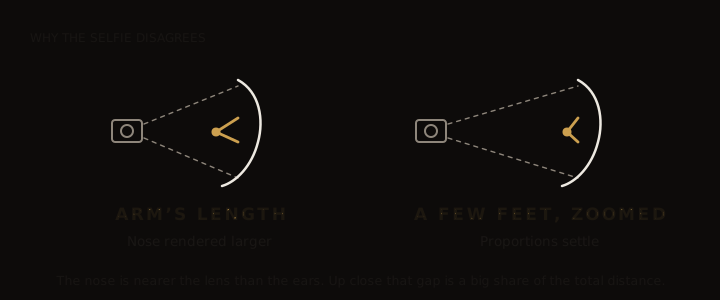
At arm's length, the distance from the lens to your nose is meaningfully shorter than the distance to your ears. Because that difference is a large fraction of the total distance, the nearest features are rendered proportionally larger. The nose grows, the ears shrink back, the face flattens outward.
This is not the camera being bad, it is how projection works at short range. A photograph taken from a few feet away with the lens zoomed in shows the proportions a person standing in front of you actually sees. The same face, the same phone, a completely different result.
It hits the nose hardest, which is exactly why the nose is the feature people are most likely to be wrong about on their own face.
3. The camera is above you
Most selfies are taken from slightly above, because that is where a raised arm puts the phone. Shooting downward foreshortens the forehead, stretches the distance between eyes and mouth, and pushes the chin back and under. It lengthens the midface and weakens the chin in one move.
Your bathroom mirror, meanwhile, is hung at eye level. So the comparison you are making is not mirror against camera, it is eye level against downward angle, which is two different views of a face before anything else is accounted for.
4. The light is wrong
Mirrors usually live in bathrooms with lights above them, but you stand close to a mirror and the reflection is continuous and moving. A photograph freezes one lighting instant. Overhead light in particular casts shadow into the eye sockets and under the cheekbones and nose, which is the classic tired look people see in a photo and not in the glass.
Direct flash does the opposite and flattens everything, erasing the structure that makes a face read as defined. Neither is what a person across a table sees.
5. A photograph is one frozen frame of a moving face
People experience you in motion: expression, micro movements, the way your face resolves over seconds. A photo takes one thousandth of that and freezes it, and one frozen frame catches transitional expressions that never register in real life. This is why a burst of twenty shots contains three you like and seventeen you do not, from an unchanged face.
It is also why video feels more like you than a still does, and why it is worth being careful about drawing conclusions from a single bad photograph.
So which one is real?
| Accurate? | |
|---|---|
| Mirror | Correct proportions, wrong orientation. It is the version nobody else has ever seen. |
| Arm's length selfie | Correct orientation, distorted proportions. Usually the least accurate of the three. |
| Photo from a few feet, eye level, zoomed, soft light | The closest available to what a person in front of you sees. |
If you want to know what you actually look like, that third row is the answer, and it takes about thirty seconds to set up. The full method is in how to take the photo.
How Forma reports it
All of this is the reason the scan is strict about the photo. A face measured from an arm's length shot taken from above will produce a genuinely different midface ratio, chin projection and nose reading than the same face measured properly, and the tool has no way to know which one it was handed.
That matters most for re scanning. Two scans are only comparable if they were taken the same way, so a change in your score between them means something changed in your face rather than in your camera position. Shooting both in the same spot, at the same time of day, in the same light, is what turns a score into a measurement.
Common questions
- Do I look like the mirror or the photo?
- Neither exactly, but the photo is closer to what other people see. A mirror shows you flipped left to right, and nobody else ever sees that version. The photo is unflipped, which is correct, but a typical selfie adds lens distortion that a viewer standing in front of you would not see. The closest thing to reality is an unflipped photo taken from a few feet away with zoom.
- Why does my face look uneven in photos but fine in the mirror?
- Because you have spent your whole life looking at the mirrored version, and your brain treats that as the correct one. Every face is asymmetric. When the image flips, the asymmetries move to the side you are not used to, and unfamiliarity gets experienced as something being wrong. The face did not change.
- Why does my nose look bigger in selfies?
- At arm's length your nose is much closer to the lens than your ears, and that difference is a large share of the total distance, so the nose is rendered proportionally larger. It is geometry rather than a fault in the camera. Step back a few feet and zoom in and the effect largely disappears.
- How do I take a photo that looks like me?
- Camera at eye level, a few feet away rather than arm's length, zoomed in to fill the frame, in soft daylight rather than overhead or direct light, and unflipped. That combination removes the four distortions that make most photos disagree with the mirror.
On Android? Get it on Google Play
Forma is a self improvement tool, not a medical or diagnostic service. Nothing here is medical advice.
Related guides
- How to take the photoThe setup that removes all four optical distortions at once.
- Facial symmetryWhy the flip bothers you, and why the mirrored half trick misleads everyone.
- Nose profileThe feature short camera distance distorts most.