Dark circles and under eye bags
Four different things get called dark circles. Two of them respond to sleep, one responds to skincare, and one does not respond to either.
Dark under eyes are caused by pigment in the skin, blood vessels showing through thin skin, fluid, or shadow cast by a hollow. Two quick tests tell you which one you have, and the answer decides whether anything you try will work.
This is the single most common complaint about the eye area, and most of the advice about it fails because it assumes one cause. Somebody with a structural hollow can sleep nine hours a night for a year and see no change, then conclude that nothing works, when what actually happened is that they treated the wrong problem.
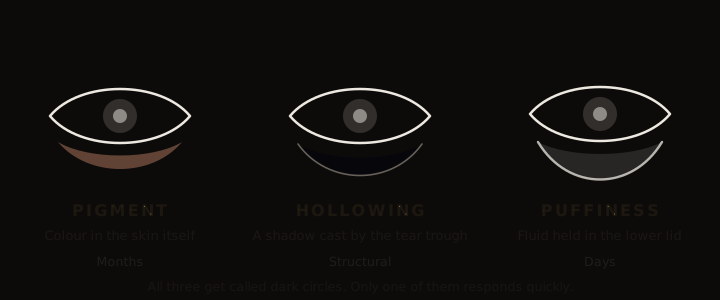
The two tests
The stretch test
Gently pull the skin beside your eye outward towards your ear, and watch the dark area.
- Darkness stays put: pigment. The colour is in the skin itself.
- Darkness fades or disappears: vascular. You are seeing blood vessels through skin thin enough to show them.
The tilt test
Stand under a light and tilt your head slowly back and forward while watching the area in a mirror.
- Darkness moves or vanishes as the angle changes: shadow. There is a hollow, and what you are seeing is the light not reaching into it.
- Darkness stays the same from every angle: colour, not shadow, so go back to the stretch test.
Do both in daylight. Bathroom downlights are directly overhead, which is exactly the lighting that manufactures the shadow you are trying to measure.
What to do about each
| Type | What helps |
|---|---|
| Pigment | Sun protection every day, since UV drives it. Some topical ingredients fade it slowly, over months rather than weeks. Often genetic and often permanent to some degree. |
| Vascular | Sleep, hydration and reduced sodium. Moisturising the area thickens the skin's appearance slightly. Cold in the morning constricts the vessels temporarily and genuinely works for a few hours. |
| Fluid | The most responsive of the four. Sleep, salt, alcohol. Sleeping with the head slightly raised stops fluid pooling overnight. |
| Shadow from a hollow | Nothing topical. The cause is the shape of the orbital rim and the fat pad below it. Concealer works, and so does front on lighting; creams do not. |
The fourth row is the one worth being blunt about. A tear trough hollow is anatomy, and an industry sells cream against it anyway. If yours is structural, knowing that saves you both the money and the sense that you are failing at something.
Bags are a separate thing
A bag is a bulge rather than a darkness: the fat pad that cushions the eye pushing forward against a loosening membrane. Fluid makes it worse in the morning and it settles through the day, which is the usual giveaway.
Sleep and sodium change how prominent it is. The pad itself is not going anywhere without surgery. Bags and hollows also frequently occur together, with the bulge above and the hollow immediately below it, which is what produces the shadowed line people describe as a permanent tired look.
When it is not cosmetic
Sudden swelling around one eye, puffiness with itching or a rash, or a change that appears over days rather than years, are all worth a doctor rather than a routine. Allergies in particular are a very common and very treatable cause of chronic under eye darkness, and they get mistaken for tiredness for years.
How Forma reports it
The under eye area feeds the eye score rather than getting a score of its own, and it sits alongside the skin detail read: clarity, texture, evenness and pores. That matters for what the plan does next, because eye area darkness driven by fluid lands in the sleep and routine tasks, while pigment lands in the skin routine, and a structural hollow correctly produces no task at all.
Common questions
- Why do my dark circles not go away when I sleep more?
- Because only some types are caused by sleep. Shadow cast by a hollow under the eye, and pigment in the skin itself, are both unaffected by rest. Sleep mainly changes fluid and the visibility of blood vessels through thin skin.
- How can I tell which type of dark circle I have?
- Two tests. Stretch the skin gently sideways: if the darkness stays, it is pigment; if it fades, it is vessels showing through. Then tilt your head under a light: if the darkness moves or disappears, it is a shadow from a hollow rather than colour in the skin.
- Do eye creams work on dark circles?
- For pigment, some ingredients help slowly. For thin skin showing vessels, moisturising and sun protection help a little. For a structural hollow, no cream reaches the problem, because the issue is the shape of the bone and fat pad rather than the skin.
On Android? Get it on Google Play
Forma is a self improvement tool, not a medical or diagnostic service. Nothing here is medical advice, and anything sudden or one sided needs a doctor rather than an app.
Related guides
- Canthal tiltThe other eye area measurement, and why swelling changes how it reads.
- Jawline definitionFluid blurs the jaw the same way it puffs the eyes.
- How to take the photoOverhead light invents under eye shadow that is not there.
- Skin texture, pores and clarityWhere pigment lands in the routine, and what actually shifts it.
- Brow ridge and brow positionThe other half of the eye area, and the faster one.