Nose profile
The nose is the feature people are most likely to dislike and the one they are most likely to be judging from a distorted photograph.
Nose shape is judged in profile against the face around it, mainly the angle where it meets the upper lip and the line of the bridge. It is bone and cartilage, so nothing non surgical changes it. Before you conclude anything, retake the photo from further away, because arm's length enlarges the nose substantially.
Start with the distortion, because it invalidates most of what people think they know about their own nose.
Your phone is lying about it
At arm's length, your nose is meaningfully closer to the lens than your ears are. That difference is a large fraction of the total camera distance, so the nose is rendered proportionally bigger. Move the camera to a few feet away and use zoom to fill the frame, and the same nose shrinks noticeably.
This is geometry rather than a flaw in the phone, and it affects the nose more than any other feature because the nose sticks out furthest. A very large share of nose dissatisfaction traces back to people comparing selfies against photographs of other people taken from a normal distance. The setup that removes it is in how to take the photo, and for this feature it is not optional.
The two measurements
Take a true side profile, camera at eye level, head neutral.
The nasolabial angle. The angle between the base of the nose and the upper lip, which describes how far the tip is rotated up or down. A more upward rotated tip makes the nose read shorter. A downward rotated tip reads longer, and the tip descends slowly with age in almost everyone, which is one reason noses appear to grow over a lifetime when the bone has stopped changing.
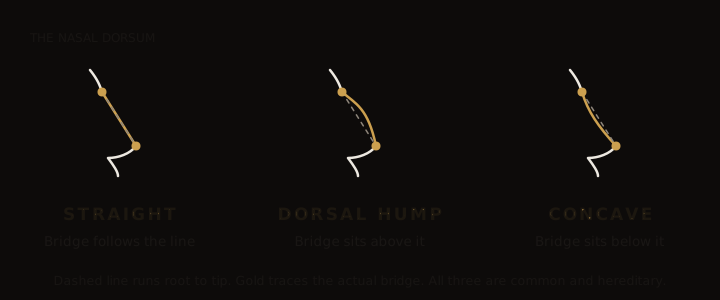
The dorsum. The line of the bridge from between the eyes down to the tip. It can be straight, slightly concave, or convex with a raised section usually called a dorsal hump. Humps are common, frequently hereditary, and become slightly more visible as the tip drops.
The nose is judged against the chin
This is the most useful idea on the page, and it is why treating the nose in isolation misleads people.
Profile balance is read across three points: nose, lips and chin. A nose reads as prominent partly because of its own size and partly because of what sits below it. The identical nose on a face with a projected chin reads as balanced, and on a face with a recessed chin reads as large, because there is nothing at the bottom of the profile to answer it.
Which means people unhappy with their nose are sometimes actually looking at their chin projection, and would get more change from the bottom of the profile than the middle of it. Worth knowing before deciding the nose is the problem.
What changes it
| Claim | Reality |
|---|---|
| Nose exercises | Do nothing. There is no muscle whose training reshapes nasal bone or cartilage. |
| Taping or clips | Do nothing lasting. Any change is temporary tissue compression and it returns. |
| Camera distance and lens | Changes the apparent size enormously. The single biggest lever available. |
| Lighting | Front on light flattens the bridge and reduces the read of a hump. Side light emphasises it. |
| Surgery | The only thing that changes the structure. A conversation for a surgeon. |
When breathing is part of it
If one side of your nose is persistently blocked, if you breathe through your mouth at night, or if you have had a broken nose that never quite settled, that is worth raising with a doctor independently of how it looks. A deviated septum is a functional issue first, and it happens to be the one nose complaint where there is a reason to get it looked at that has nothing to do with appearance.
How Forma reports it
Nose measurements are read from the side profile and feed the bone structure score, flagged as structural. No task is generated against nose shape, because there is no honest one to give. Where the scan can help is context: it reports the nose alongside chin projection and the lower third proportions, which is the comparison that tells you whether the nose is genuinely prominent or simply unanswered by the chin.
Common questions
- Why does my nose look bigger in selfies?
- Because it is closer to the lens than the rest of your face. At arm's length the difference in distance between your nose and your ears is a large fraction of the total distance, so the nose is rendered proportionally larger. Step back and use zoom and the effect mostly disappears. This is a property of distance rather than of the camera being bad.
- What is a dorsal hump?
- A raised area along the bridge of the nose, visible in profile, made of bone and cartilage. It is extremely common, it is often hereditary, and it becomes slightly more pronounced with age as the tip descends. It is anatomy rather than a fault.
- What is nasal tip rotation?
- How far the tip of the nose points upward or downward, usually described through the angle between the base of the nose and the upper lip. A more upward rotated tip reads shorter and is more common in faces read as feminine. A downward rotated tip reads longer. It is set by cartilage and it descends gradually with age.
- Can you change your nose without surgery?
- Not the structure. Nose shape is bone and cartilage, and exercises, taping and devices do not reshape either. What changes the appearance is camera distance, lighting, and the balance of the features around it, particularly the chin, because a nose reads as large partly in relation to what sits below it.
On Android? Get it on Google Play
Forma is a self improvement tool, not a medical or diagnostic service. Nothing here is medical advice, and nothing here is a recommendation for or against surgery. Persistent breathing problems are a matter for a doctor.
Related guides
- Chin projectionThe feature your nose is actually being judged against.
- How to take the photoCamera distance distorts the nose more than any other feature.
- Facial thirds and fifthsThe middle third the nose defines, and the columns it sits in.