Chin projection
A weak chin is something you can only see from the side, which is why so many people have opinions about theirs based entirely on front facing photos.
Take a profile photo at eye level and drop a vertical line from the most forward point of your lower lip. Chin on the line is typical, well behind it reads recessed, ahead of it reads strong. It is bone, so nothing you do moves it, and it gets confused with two entirely different problems.
Chin projection does a surprising amount of work in how a face reads, and almost all of it happens in profile. It sets whether the jaw looks like it has a defined endpoint, it changes the apparent length of the neck, and it interacts with the nose to produce the balance people describe when they say a profile works or does not.
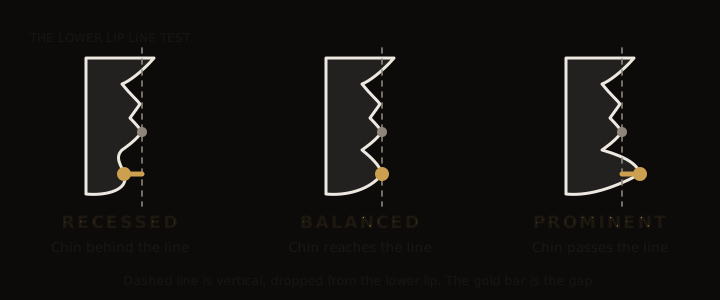
The line test
You need a genuine side profile: camera at eye level, head neutral rather than tilted, mouth closed and relaxed. Head tilt ruins this measurement faster than any other, because tucking your chin swings it backwards and lifting it swings it forwards. Same bone, opposite answers.
Then drop a vertical line down from the most forward point of your lower lip and read where the chin sits relative to it.
- Roughly on the line: typical projection.
- Clearly behind it: recessed, what gets called a weak chin.
- Clearly ahead of it: prominent or strong projection.
A second common check runs a line from the tip of the nose to the chin and looks at where the lips sit relative to it. That one describes the balance between nose, lips and chin together rather than the chin alone, which is often the more useful framing: a chin can read as weak simply because the nose in front of it is prominent.
The three things it gets confused with
| Not the same as | What it actually is |
|---|---|
| A double chin | Fat and skin under the jaw. Responds to body composition. A recessed chin makes it more visible because there is less bone in front to draw a clean line, which is why the two get blamed on each other. |
| A weak jaw | Jaw width and the angle at the back corner. A face can have a wide, sharp jaw and a recessed chin, or a narrow jaw and a strong chin. Covered in jawline definition. |
| A short lower third | The vertical height from nose to chin, which is a proportion rather than a projection. Covered in facial thirds. |
Sorting out which of the four you actually have is most of the value here, because three of them have different answers and one of them has a real one.
What changes it
Nothing non surgical changes the projection. It is the shape and forward position of the mandible. Chewing devices, exercises and posture techniques all act on muscle or soft tissue, and none of them move the bone. Anything sold on the promise of building a chin is selling the fat loss underneath it.
Body fat changes how clearly it reads. Submental fat, the pad under the chin, blurs the line between chin and neck. Reducing it does not project the chin forward, but it does reveal the transition, and for many people that is the entire visible difference they were after.
Posture changes what people see day to day. Not the measurement, but a head held forward of the shoulders visually eliminates the space under the chin. This is genuinely worth attention, because most people are looked at while sitting at a desk or looking down at a phone rather than in a neutral profile photo.
Surgery changes it. Implants and genioplasty are the real options and both are a conversation for a surgeon. Worth knowing they exist, and equally worth knowing that a recessed chin is extremely common and is not a medical problem.
When it is worth mentioning to a dentist
A markedly recessed chin sometimes accompanies a jaw position that also affects the bite, and occasionally the airway during sleep. If you have a recessed chin alongside persistent snoring, waking unrested, or a bite that does not meet properly, that combination is worth raising with a dentist or doctor. Not because your face needs fixing, but because those are separate things worth checking on their own terms.
How Forma reports it
Chin projection is read from the side profile photo, which is the reason the scan asks for one at all. It feeds the bone structure score and it is flagged as structural, so the plan issues no task against it. Where the scan finds submental fullness masking the chin and jaw transition, that does produce a task, because it is the one contributing factor that moves.
Common questions
- How do you know if you have a weak chin?
- Take a side profile photo at eye level with your head neutral, then drop a vertical line down from the most forward point of your lower lip. If your chin sits roughly on that line, projection is typical. If it falls well behind it, the chin reads as recessed. If it sits ahead of it, it reads as strong or prominent. It is a profile measurement and cannot be judged from a front photo.
- Can chin exercises fix a weak chin?
- No. Chin projection is the shape and position of the mandible, which is bone. Exercises work muscle, and there is no muscle whose size changes how far forward the bone sits. What exercise and body composition can change is the fat and skin under the chin, which affects how clearly the jaw and chin read but not how far the chin projects.
- Is a weak chin the same as a double chin?
- No, and they are constantly confused. A weak chin is bone sitting further back. A double chin is fat and skin below the jaw. You can have either without the other, though a recessed chin does make submental fullness more visible because there is less bone in front of it to create a clean line.
On Android? Get it on Google Play
Forma is a self improvement tool, not a medical or diagnostic service. Nothing here is medical or dental advice, and nothing here is a recommendation for or against surgery.
Related guides
- Jawline definitionThe measurement this is most often mistaken for.
- Nose profileThe other half of the profile balance, and the reason a chin can read weak.
- Philtrum lengthThe other lower third measurement, and equally fixed.