Masculine and feminine features
Facial dimorphism is a set of tendencies with huge overlap, not two boxes people get sorted into. Here is what the markers actually are, and which of them respond to anything you do.
Seven features carry most of the signal: brow projection, jaw width, jaw angle, chin shape, midface length, lip fullness and eye exposure. All of the bone ones are fixed after your early twenties. The soft tissue over them is not, and that is where every real change lives.
This is one of the most searched things in facial analysis and one of the most badly explained. It gets presented as a scoreboard where one end is good, and that is both wrong and useless. Dimorphism describes which direction a face leans on a set of measurements. Faces at every point on that range are attractive, and most faces are a mix rather than a clean lean in one direction.
The genuinely useful version is narrower: knowing which markers are bone tells you what to stop trying to change.
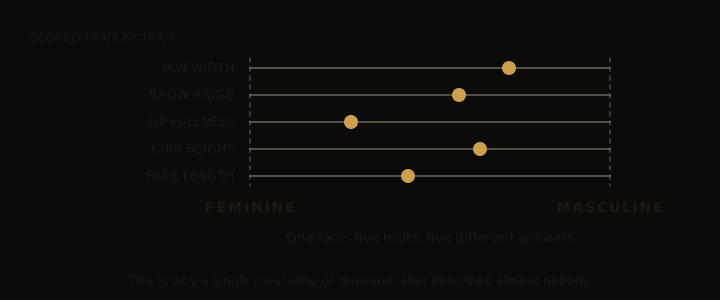
The markers
| Feature | Reads more masculine | Reads more feminine | Movable? |
|---|---|---|---|
| Brow ridge | More projected, heavier shelf over the eye | Flatter, smoother forehead into brow | No, bone |
| Jaw width | Wider at the angle, less taper from cheek to jaw | Narrower, more taper | No, bone |
| Gonial angle | Closer to a right angle, sharper corner | More obtuse, softer curve | No, bone |
| Chin | Squarer, broader, more forward projection | Narrower, more tapered or pointed | No, bone |
| Midface length | Longer | Shorter | No, bone |
| Lip fullness | Thinner relative to face height | Fuller relative to face height | Partly, ages and can be altered |
| Eye exposure | Less visible lid, heavier brow sitting lower | More visible lid and eye area | Partly, via brow and hooding |
Five of the seven are bone. That is the headline, and it is why this feature produces so much wasted effort: the majority of what people are chasing here finished forming before they started thinking about it.
Overlap is the norm, not the exception
Every one of those markers is a distribution with a very large shared middle. Plenty of men have flat brow ridges and plenty of women have wide jaws, and neither is unusual or a problem. A face usually reads as leaning one way because of two or three strong markers rather than a clean sweep of all seven, which is why two people with similar measurements on paper can be read completely differently.
This also means a single measurement tells you almost nothing. A wide jaw on a face with a short midface and full lips does not read the same as a wide jaw on a long midface with thin lips. The combination is the thing, which is why any tool giving you one dimorphism number is compressing something that does not compress well.
What actually moves the read
Body fat. The largest available change by a distance. Lower body fat sharpens angles, reveals the jaw and cheekbone, and shifts the read in the direction usually described as more masculine. Higher body fat softens contours and shifts it the other way. This is the same mechanism covered in jawline definition and it works on everyone.
Hair. Brow thickness and shape, facial hair, and hairline framing. Collectively these move the read more than most people expect, they are fast, and they are reversible. See brow ridge and brow position.
Not testosterone, in adults. Facial bone responds to hormones while the growth plates are open, which is puberty. After that they close. Changes people attribute to hormones in adulthood are almost always changes in body composition, water retention or hair, all of which are real effects on the soft tissue rather than the skull changing shape.
Not exercise of the face. Chewing devices load the masseter, which is a muscle. A larger masseter can slightly widen the lower face. It does not change the gonial angle, the bone width or anything else on the list, and the effect is small and easy to overstate.
How Forma reports it
Dimorphism appears in the impression axes rather than as a score, because it is a direction rather than a quality, and scoring it out of a hundred would imply one end is a pass. The scan reports which way the measurements lean and, more usefully, marks which contributing features are bone. The plan then only issues tasks against the soft tissue markers, because those are the only ones where effort produces a result.
Common questions
- What makes a face look masculine or feminine?
- Mainly brow ridge projection, jaw width and angle, chin shape, midface length, lip fullness relative to the face, and how much of the eye is visible. These are population level tendencies with enormous overlap, not rules. Plenty of faces sit in the middle on most markers and read clearly as one or the other because of two or three of them.
- Does testosterone change your face as an adult?
- It does not reshape the skull. Facial bone growth responds to hormones during puberty and then the growth plates finish. In adults, changes in body composition alter how the existing bone reads by changing the soft tissue over it, and that is a real and visible effect, but it is not the bone changing shape.
- Can you make your face look more masculine or more feminine?
- The soft tissue layer moves and the bone does not. Body fat, hair, brow shape and grooming all shift the read meaningfully and quickly. Lower body fat sharpens angles and tends to read more masculine, while softer contours read more feminine. None of that changes the underlying structure.
On Android? Get it on Google Play
Forma is a self improvement tool, not a medical or diagnostic service. Nothing here is medical advice, and nothing here is a statement about anyone's gender. These are measurements of faces, and faces do not sort people.
Related guides
- Jawline definitionTwo of the seven markers, and the one layer that moves.
- Brow ridge and brow positionThe strongest marker on the list, and the fastest thing near it.
- Midface ratioThe measurement most people have never heard of and cannot change.