Buccal fat and hollow cheeks
A pad of fat deep in the cheek that barely responds to weight loss, shrinks on its own with age, and is the subject of the one facial procedure you genuinely cannot undo.
The buccal fat pad sits deep in the cheek and resists general weight loss, which is why some very lean people still have full cheeks. It shrinks naturally with age. Removing it is permanent, and the thing it is blamed for at twenty is often the thing keeping a face from looking gaunt at forty.
This has become one of the most searched facial topics, largely because a run of celebrities visibly had it done and the internet noticed. Most of the discussion skips the two facts that actually matter: it is not the same fat as the rest of your face fat, and it goes away by itself eventually.
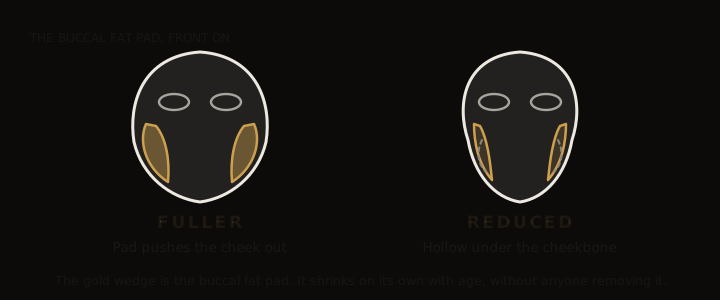
Where it is and what it does
The pad sits deep, between the muscles of the cheek, roughly below and slightly behind the cheekbone. It is a distinct structure rather than part of the general layer under the skin, which has two consequences.
- It resists dieting. Losing body fat thins the subcutaneous layer over the whole face. The buccal pad shifts far less. This is why a lean person can still have full lower cheeks and conclude, wrongly, that they have not lost enough weight.
- It holds the shape of the mid cheek. It contributes volume that keeps the area between cheekbone and jaw from collapsing inward.
The ogee curve
What people are usually chasing here is the ogee curve: seen from a three quarter angle, an S shape running from beside the eye, out and over the cheekbone, then in to the hollow beneath it. Convex flowing into concave.
The convex part is cheekbone, which is bone and fixed. The concave part is the hollow below it, and how deep that reads depends on the subcutaneous fat, the buccal pad, and where the light is falling. Which means the sculpted look people attribute entirely to buccal fat is mostly a combination of the bone above it and the light on the day.
Age does this for free
This is the part that changes the decision, and it is rarely mentioned alongside the before and after photos.
Facial fat pads shrink and descend from roughly the thirties onward. The buccal pad is among them. The natural direction of travel for every face is toward more hollowing, not less. A face that reads as full and round in the twenties frequently arrives at a defined mid face on its own, without intervention, and the same volume that felt like a problem then is what keeps the face from looking drawn later.
So the question is not only whether you want less volume now. It is whether you want less volume in twenty years, when the process that was already underway has continued and there is no pad left to lose.
Why permanence matters here more than elsewhere
| Reversible? | |
|---|---|
| Losing body fat | Yes, entirely. Regain and the face fills again. |
| Filler | Mostly. Some types dissolve, and all of them fade over months. |
| Brow, hair, grooming | Yes, on a timescale of weeks. |
| Buccal fat removal | No. The pad is gone and does not regrow. |
Almost every other lever in facial appearance can be walked back. This one cannot, and it is being made most often by people in their twenties whose faces have not finished changing. That is not an argument against anyone's choice. It is an argument for knowing that this specific decision is different from the others on the list.
What to do before considering it
Establish what is actually causing the fullness, because there are four candidates and only one of them is the buccal pad.
- Overall body fat. The largest contributor for most people, and fully reversible. Worth resolving first, because it changes the answer.
- Fluid. Sodium, alcohol and sleep move the face within days. Judge your cheeks on a normal week, not the morning after a bad one.
- Masseter size. The chewing muscle at the back of the jaw. Large masseters widen the lower face and get mistaken for cheek fat regularly.
- The buccal pad itself. What is left after you have accounted for the other three.
How Forma reports it
Mid face fullness feeds the bone structure and facial fat reads rather than appearing as a buccal fat score, because a photo cannot separate a deep pad from the layer above it with any honesty. What the scan can do is tell you whether your mid face fullness tracks with your overall facial fat, which is the distinction that decides whether losing body fat will change anything. Where it will, that becomes a task with a timescale. Where the shape is structural, the plan says so and moves on.
Common questions
- What is the buccal fat pad?
- A discrete pad of fat sitting deep in the cheek, between the facial muscles, roughly below and behind the cheekbone. It is separate from the layer of fat directly under the skin, and it is one of the few fat deposits in the body that does not respond much to overall weight loss.
- Can you lose buccal fat naturally?
- Not reliably. It is relatively resistant to general weight loss compared to the subcutaneous fat around it, which is why some very lean people still have full cheeks. It does tend to shrink and descend on its own with age, which is one of the reasons faces hollow out in the decades after thirty without anyone trying.
- Is buccal fat removal reversible?
- No. The pad is removed and it does not grow back. That matters more than it sounds, because the same pad that reads as heavy at twenty is doing structural work at forty, when the face is naturally losing volume anyway. Reversing it later means adding volume artificially rather than restoring what was there.
- What is the ogee curve?
- The S shaped line running from the outer eye area, over the cheekbone, and inward to the hollow beneath it, seen at a three quarter angle. A convex highlight flowing into a concave shadow. It is one of the more reliable descriptions of what people mean by a sculpted mid face.
On Android? Get it on Google Play
Forma is a self improvement tool, not a medical or diagnostic service. Nothing here is medical advice and nothing here is a recommendation for or against surgery. Any procedure is a conversation for a qualified surgeon who has examined your face.
Related guides
- CheekbonesThe bone above the hollow, and the ceiling on all of this.
- Jawline definitionBone, fat and fluid, and which two actually move.
- Midface ratioThe height of the area this pad sits inside.